


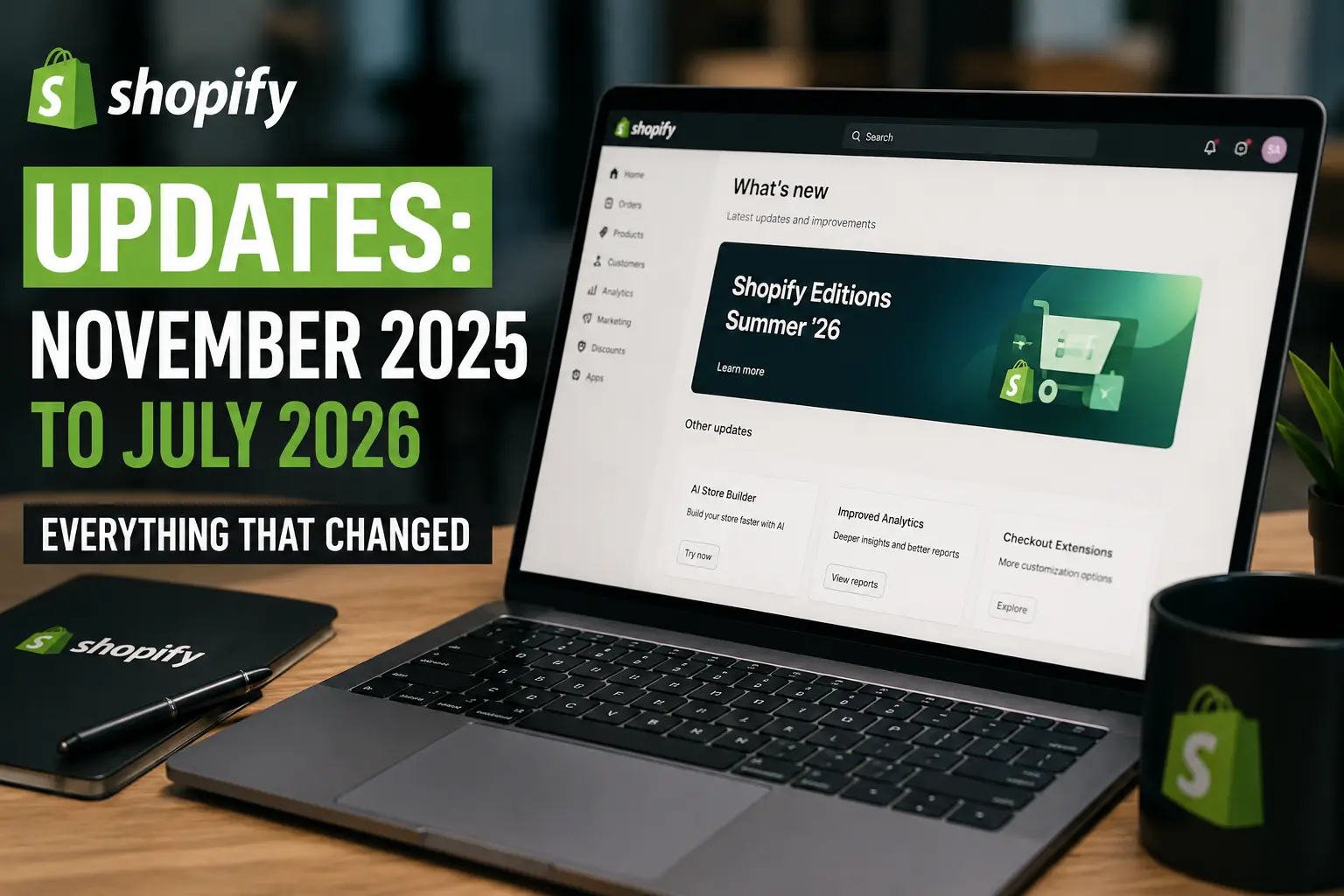
Shopify Updates: November 2025 to July 2026 — Everything That Changed
Table of Contents
Shopify does not sit still, and the last nine months have been busier than most. Between one holiday-season prep month, two full seasonal Editions, a Scripts shutdown, and a steady drip of smaller admin and API changes, there is a lot for merchants and developers to catch up on. Here is a timeline of what shipped, grouped by when it landed and why it matters.
November 2025: Getting Ready for the Holidays
November was a lighter month by design — Shopify’s focus was squarely on retail and point-of-sale ahead of Black Friday/Cyber Monday, plus a few developer-facing changes that quietly reshaped what themes and apps could do.
- Variant limits jumped from 100 to 2,048 per product. This was the headline change for theme and app developers. Older themes were not built with that ceiling in mind, and some started behaving unpredictably once product variants crossed roughly 250 — worth testing directly if you are maintaining a store with large variant counts.
- A new VS Code–based theme editor rolled out for developers, alongside continued refinement of the existing admin theme editor.
- POS got a compact layout aimed at high-volume retail, cutting the number of taps needed for common tasks like adding items, applying discounts, and processing returns.
- Returns got more flexible. Customers can now be refunded to a store gift card instead of the original payment method, and staff can process a return without a receipt or order number by looking the order up via customer name, email, or card.
- Post-purchase pages became customizable. The “Thank You” and “Order Status” pages can now carry upsells, loyalty prompts, and feedback forms through Shopify’s extension framework.
- Collections got a “Duplicate” button, handy for seasonal variants or A/B testing a collection layout without rebuilding it from scratch.
- Draft orders and DDU (Duty Delivered Unpaid) orders now recalculate pricing and tax automatically when a customer’s shipping address changes.
- Smaller but notable: Apple Pay arrived inside Shop Pay checkouts, the Shop app added ten new languages, and — as of late August 2025 — merchants became responsible for their own tax filing on Meta/Instagram orders now that Meta no longer acts as marketplace facilitator.
December 10, 2025: The Winter ’26 “RenAIssance” Edition
Shopify’s seasonal Editions bundle months of work into one announcement, and Winter ’26 was one of the biggest yet — over 150 updates under an unmistakably AI-first theme.
Sidekick stopped being just a chatbot. The built-in AI assistant gained multi-step task execution, meaning it can now carry out an entire workflow rather than just answer a question. Merchants can ask it to draft a Shopify Flow automation in plain language (“tag orders over $200”), generate a small custom app from a description, or edit theme settings by describing the change they want (“make this button rounder”) instead of digging through the theme editor. Reusable prompts, called Sidekick Skills, can be saved and shared across a team.
Agentic Storefronts put products directly into AI conversations on ChatGPT, Microsoft Copilot, and similar platforms — the first real step toward Shopify’s bigger agentic-commerce push that would come to a head in Spring ’26.
SimGym launched in research preview — an AI-shopper simulation tool that lets merchants stress-test storefront changes against simulated buyer personas before pushing them live.
Other Winter ’26 highlights worth knowing:
- POS Hub, new dedicated retail hardware for wired, no-pairing peripheral connections.
- Inventory transfers became easier to correct after creation, with new compare-and-swap logic and idempotency keys to reduce accidental over-writes.
- Checkout branding (logo, colors, typography) now applies consistently across checkout, customer accounts, and sign-in pages from a single editor.
- The Liquid code editor gained multi-file search, syntax highlighting, and side-by-side version diffs.
- Storefront MCP support for Hydrogen, letting headless storefronts plug into AI agent tooling and be discoverable through the Shopify Catalog.
January–May 2026: Steady, Incremental Progress
No headline Edition landed in this stretch, but the changelog kept moving:
- Shopify Flow moved to the 2026-01 GraphQL Admin API, improving metafield and metaobject querying.
- The admin got workflow edit history in Flow (who changed what, and when) and the ability to attach notes to a workflow.
- Customer account pages were redesigned with a mobile-first, single-column layout.
- Plus and Enterprise merchants gained the ability to let customers choose shipping for some items and store pickup for others within a single order.
- Address format validation in Checkout Blocks rolled out to all merchants, catching non-compliant shipping addresses before they cause delivery problems.
- The “Compare to Benchmarks” toggle was removed from Shopify Analytics reports (May 19).
- The mobile Online Store Editor was rebuilt to keep the canvas visible while editing, with Sidekick made available inside the editor for the first time.
- Behind the scenes, Shopify continued changing how it processes Liquid for performance, explicitly noting no merchant action was needed.
The Shopify Scripts Sunset (April 15 – June 30, 2026)
If you are maintaining an older store, this is the deadline that mattered most this year. Shopify Scripts — the legacy way of customizing discounts, shipping rules, and payment-method gating with Ruby — stopped accepting edits or new publishes on April 15, 2026, and stopped executing entirely on June 30, 2026. Anything still relying on Scripts for checkout logic needed to migrate to Shopify Functions or a public app well before that date. Stores that missed it saw discounts, shipping rules, or payment gating silently stop working the day Scripts shut off — worth an immediate test order if you inherited a store and are not sure what it is running on.
June 17, 2026: The Spring ’26 “Everywhere” Edition
Spring ’26 landed with 150+ updates (some outlets counted over 200 once every sub-feature was tallied) under the theme “sell, shop, and build everywhere.” If Winter ’26 was about making Sidekick smarter, Spring ’26 was about making Shopify’s commerce infrastructure available anywhere a shopper might be — including inside an AI chat.
The Universal Commerce Protocol (UCP), co-developed with Google, is the biggest structural change here. It is an open standard that lets AI agents discover products, build carts, and complete checkout using a shared language, and Shopify merchants are enabled for it by default.
Shopify Catalog rolled out to every developer using MCP tools or the REST API (previously limited to select partners since Summer ’25). It structures and standardizes product data specifically so AI agents can read it accurately — Shopify’s own reporting suggests AI-driven searches using clean Catalog data convert at roughly twice the rate of scraped/unstructured data, which makes product-data hygiene a real priority now rather than a nice-to-have.
Other major Spring ’26 changes:
- Hydrogen was rebuilt to run on any stack, including Next.js and hosting on Vercel — no longer tied exclusively to Shopify’s own hosting.
- Native A/B testing arrived for storefronts and checkout, replacing a category of paid third-party testing apps.
- POS v11 redesigned the retail checkout flow — the cart now stays on screen through an entire transaction, with discounts, edits, and lookups opening in a side panel, saving over a minute on complex carts according to Shopify’s own testing.
- B2B features that used to require Shopify Plus (custom pricing, quantity rules, company accounts, and more) are now available on Basic, Grow, and Advanced plans.
- Shop Pay opened up to any business on any platform — you no longer need to be a Shopify merchant to offer Shop Pay’s one-tap checkout to its 250M+ user base.
- Campaign Autopilot, an AI system that runs and optimizes marketing campaigns across ChatGPT, Pinterest, and programmatic ads (via Microsoft Monetize) from a single setup, with merchant-set guardrails.
- Sidekick now connects to third-party apps — starting with Klaviyo, Judge.me, Loop, and Smile — so merchants can ask it questions and take actions without leaving the Shopify admin.
- The Shopify AI Toolkit bundles the Dev MCP Server with agentic coding skills, with support for Claude Code, Cursor, VS Code, and Gemini CLI.
- Checkout itself got a mobile redesign with fewer scrolling steps, plus support for splitting shipping and in-store pickup across items in a single checkout.
One useful reality check worth passing on to clients: agentic checkout specifically has hit some friction — OpenAI pulled back ChatGPT’s Instant Checkout feature in March 2026. The discovery and recommendation side of agentic commerce (Catalog, UCP) is real and growing; fully autonomous AI-driven purchasing is still working itself out.
July 2026: The Month So Far
- A new €3 EU import customs duty now applies per tariff line on qualifying orders up to €150 shipped into the EU from outside it (effective July 1). It is calculated and collected at checkout alongside VAT — note it is charged per tariff line, so a cart spanning several product categories can rack up multiple €3 charges, not just one.
- Self-serve returns now support order cancellations, not just returns.
- POS staff attribution is now on by default for stores that had not configured it (as of July 6), making it easier to track who sold what for commission and performance reporting.
- Draft order deposits are now available through the GraphQL Admin and Customer Account APIs for Plus stores.
- Market-driven shipping entered feature preview — it reorganizes a merchant’s shipping setup around the markets they sell into. Full rollout is scheduled to begin October 1, 2026, with all merchants migrated by July 2027, so this is one to start testing in a development store now rather than later.
What This Means If You Are Running a Store
A few practical takeaways, roughly in priority order:
- Confirm your Scripts migration actually happened. If a store you inherited or maintain still shows odd discount/shipping/payment behavior, this is the first thing to check.
- Audit your product data before leaning on AI discovery. Clean titles, filled-in metafields, and unambiguous variant naming (Shopify’s own example: “Navy” vs. “Dark Blue” vs. “Midnight”) directly affect whether Catalog surfaces your products correctly in AI channels.
- If you are on Shopify Plus for B2B features alone, it is worth re-checking whether Basic, Grow, or Advanced now covers what you need since Spring ’26.
- Test large-variant products against the new 2,048 ceiling, especially on older or heavily customized themes.
- If you ship into the EU, make sure the €3 customs duty is displaying correctly at checkout for affected orders.
Shopify’s release pace is not slowing down, and a lot of these changes — Scripts deprecation especially — have quiet failure modes that do not show up until a customer hits checkout. If you want a second set of eyes on how your store is handling any of this, that is exactly the kind of audit I help clients with.
Let's Build Your Next Website
Have a new website project or need to improve an existing one? Whether you need custom HTML & CSS development, a WordPress website, or a Shopify store, share your requirements and let’s discuss the right solution for your business.






0 Comments
No Comments